
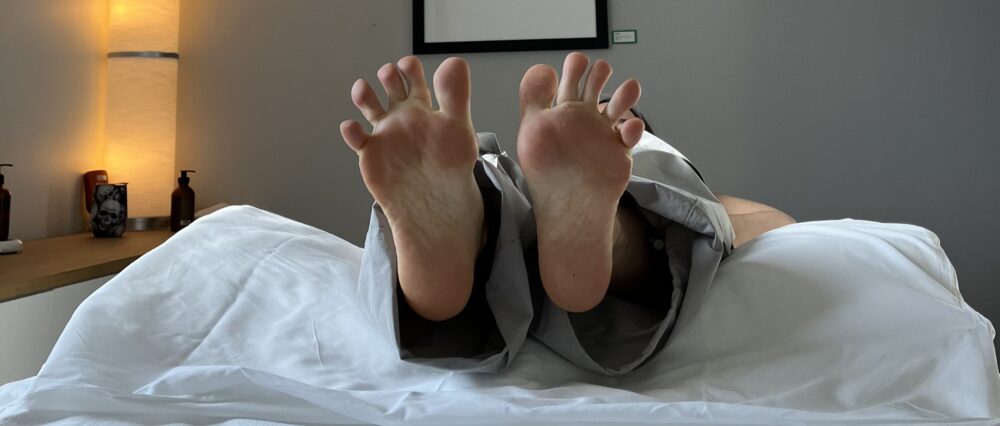
Hey Ottawa, we’re entering plantar fasciitis season!
In my massage therapy practice, I see a noticeable increase in clients experiencing foot and heel pain when the seasons change. And it’s not necessarily because you’ve done anything wrong. Your shoes change, your routines change, your activity levels change—and your feet have to adapt.
Even the small things can add up. And seemingly out of nowhere, your heel starts to hurt.
You may notice it first when you get out of bed in the morning. Those first few steps are uncomfortable, but it seems to ease as you move around.
You tell yourself it will go away and sometimes it does.
But sometimes those first few steps become every few steps.
This is one of the ways plantar fasciitis can begin.
Your feet are adapting to a new job
Even after you invested in a better pair of shoes or expensive insoles because you are committed to walking more… But your body still has to adapt to the change.
Your shoes influence where your weight lands, how much your ankle moves, how your foot rolls through each step, and which muscles have to work to stabilize you.
Change the shoes, and you change the workload.
Think about switching from a flexible summer shoe to a structured fall boot. Or from a flat shoe to something with more cushioning or arch support.
Even though your new shoes may be objectively “better,” they can change the way you move. And your muscles have to reorganize around that change.
Your plantar fascia shouldn’t have to do everyone’s job
The plantar fascia is a strong band of connective tissue running along the bottom of your foot. It helps support the arch and plays an important role in how your foot absorbs and transfers force as you walk.
But it isn’t working alone.
Your foot, ankle, calf and the muscles throughout your lower leg all contribute to how force moves through you.
When some muscles aren’t doing their share of the work—or aren’t coordinating well with the others—the plantar fascia can end up taking on more load.
But aren’t orthotics supposed to help?
They absolutely can.
For some, supportive shoes or orthotics can be an important part of managing foot pain. They can change how load is distributed and reduce irritation while things settle down.
The problem is not support itself.
The question is what happens next?
If your foot is always being supported from underneath, it has less opportunity to develop the strength and coordination needed to support the weight of your body.
Think of it like a crutch.
A crutch can be incredibly useful when you have broken bones. But the goal isn’t usually to spend the rest of your life leaning on it.
The goal is to provide your body with the support to heal enough to safely bear again.
For plantar fasciitis, that can means using support while also working on the underlying strength and movement patterns that contributed to the problem in the first place.
Support and strengthening don’t have to be competing philosophies.
They can be two parts of the same strategy.
Why catching it early matters
This is the part I really want people to know.
Don’t wait until your foot hurts every day.
When plantar fasciitis becomes established, it can be surprisingly stubborn.
You start changing how you walk because it hurts.
Then the way you walk changes how your muscles work.
You avoid certain activities.
You wear the shoes that hurt less.
You move differently.
The muscles compensate.
And the cycle can become harder to unwind.
The good news is that early discomfort is information.
That morning heel pain is your body telling you something has changed.
It doesn’t necessarily mean you need to stop walking, buy the most expensive insert available, or resign yourself to having a “bad foot.”
It means it’s worth paying attention.
Start looking at the whole system
If your feet have started complaining recently, ask yourself:
What’s changed?
- Did you switch from sandals to boots?
- Did you change your everyday shoes?
- Are you wearing a completely different heel height?
- Did you start wearing shoes with significantly more—or less—support?
- Are you walking more now that the weather has cooled?
- Are you standing longer at work?
- Did your exercise routine change?
- Are you spending more time on hard surfaces?
- Have you recently started carrying a heavier bag?
- Have you been sitting more and moving less?
- Did your foot pain begin after a seemingly unrelated change?
The answer is usually surprisingly simple—this is where I can help.
The important thing is not to blame the shoe.
Or the orthotic.
Or your feet.
Your body is constantly adapting to the demands you place on it.
The goal is to understand how it is adapting.
My approach: take the workload off, then build capacity
When I work with someone experiencing plantar fasciitis, I don’t want to simply chase the painful spot.
I want to understand why that tissue is being asked to work so hard in the first place.
Treatment can help release muscular restrictions and reduce the imbalances that are contributing to the problem. Then, through personalized exercises, we can begin restoring the strength and coordination your foot and leg need to share the workload more effectively.
Because ultimately, I don’t want your body to need me forever.
I want you to understand what’s happening, become stronger, and have more tools to manage your body yourself.
Your feet are incredibly adaptable.
Give them the right conditions, the right amount of support when needed, and an opportunity to get stronger—and they can often do much more for you than you realize.
So as you pull your boots out of the closet this fall, pay attention to your feet.
They’re adapting to the season, too.
Most of my clients will experience some degree of relief after the first treatment. This is usually short-lived, because the body is eager to revert to the old pattern—but it does provide encouragement to know that the pain your are experiencing is not permanent, and that we have located the source.
Plantar fasciitis can be stubborn, but that doesn’t mean you need an endless series of treatments.
Your first treatment includes an assessment and targeted massage to address the muscular imbalances that may be contributing to the problem. You’ll leave with personalized exercises to help restore strength and balance as your body adapts.
Many of my clients choose to book a follow-up treatment to support the legs and feet as the muscles adjust and strengthen. But the goal is always to help you become more self-sufficient, not to keep you coming back indefinitely.
Less than 10 minutes/day.
No—but I do recommend continuing the exercises for several weeks to months after your pain has resolved. This allows your body to build the strength needed to maintain a pain-free state.
This type of pain can return if the underlying weakness isn’t fully addressed, so staying consistent—even after the pain is gone—is key.